China’s Stage Two Coercion of Rare Earth
Supply Chains — Rising Risks
More than a Tactic, it is a Control System Sprung on the Global Economy
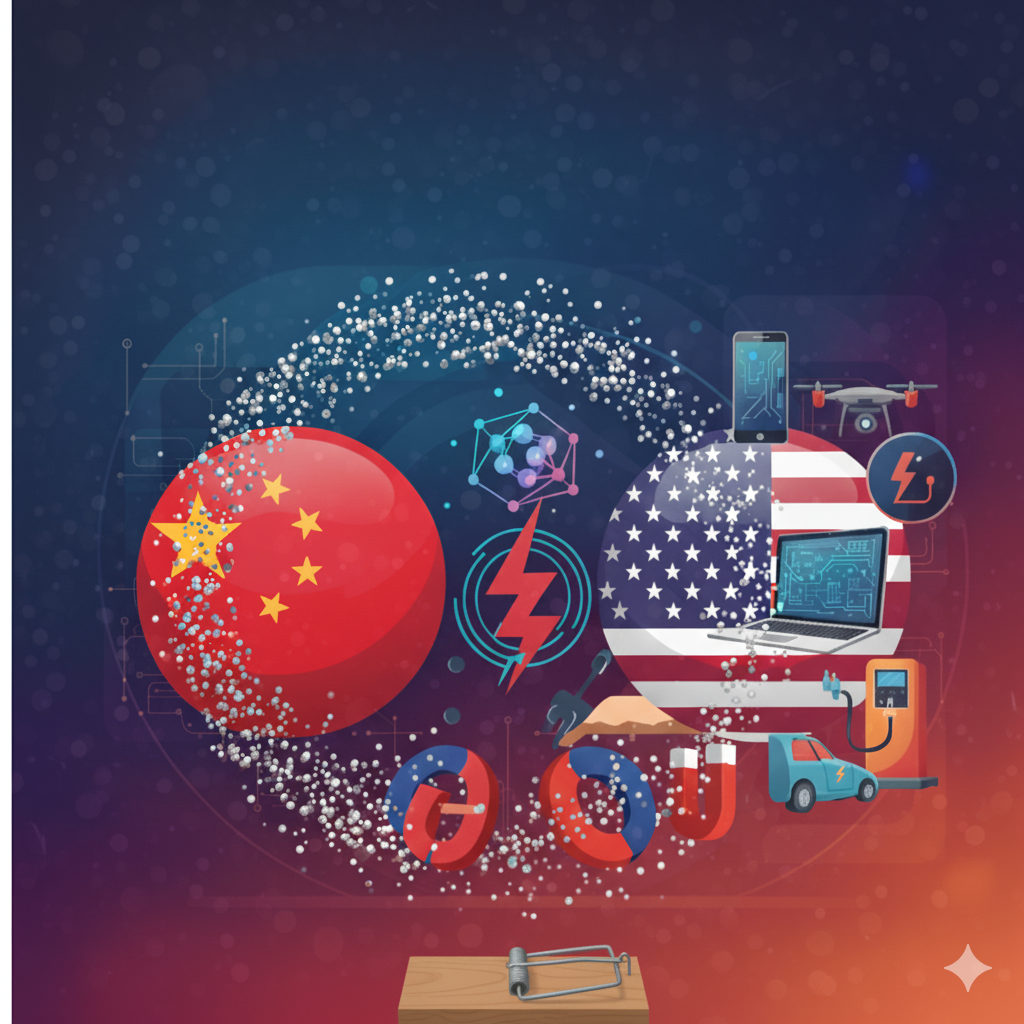
Published on LinkedIn, October 12, 2025
Overview:
Global markets may be underestimating the significance of China’s latest move on rare earth materials. On Thursday, October 9, 2025, Beijing activated Stage II of its strategic export control campaign, expanding rare-earth export controls in a way that structurally increases geopolitical risk across global manufacturing. This is not a routine trade measure and it should not be dismissed as another round of tit-for-tat between Washington and Beijing. China has now embedded political approval risk into the supply chains for electric vehicles, defense systems, power infrastructure, medical equipment, and advanced electronics.
For investors, this means lower probabilities of meaningful U.S.–China trade stabilization and higher systemic risks for all industries dependent on Chinese processing and component manufacturing. Markets have not priced in this new paradigm. With China controlling 90% of rare-earth refining and over 92% of permanent magnet production, experienced China watchers will understand it is using enforcement intimidation—tested domestically on Chinese tech, finance, and real estate firms—and is now extending that model to the world. What changed last week is not just the supply of all of its rare earth materials —it is who has the power to grant permission.
What China Actually Announced:
China’s move did not arrive all at once—it escalated in two steps this year. On April 4, 2025 (MOFCOM Notice No. 18), Beijing imposed export controls on seven strategic heavy rare earth elements used in EV motors and missile guidance systems. This step quietly put China in legal position to restrict access to the very metals required for missile guidance, fighter jet actuators, hypersonic components, and high‑efficiency EV motors—a direct strategic signal to the U.S. military and its allies. The most consequential rule buried in this announcement was this: exporters were required for the first time to declare end‑use and self‑identify whether their goods fell under Chinese dual‑use classifications, giving Beijing visibility into global rare‑earth supply chains.
Then on October 9, 2025 (MOFCOM Notice No. 61), China escalated from strategic military leverage to systemic industrial leverage to all related exports. This brief but far‑reaching announcement made clear that any Chinese exporter of rare earth materials must now seek government approval if those materials account for 0.1% or more of a product’s value—effectively inserting Beijing into every supply chain decision involving rare earths worldwide. This means Beijing now has a legal mechanism to slow, review, or block exports of EV motors, aerospace components, medical equipment, wind turbines, industrial automation systems, and even smartphones—not just military systems.
The most consequential rule buried in both announcements is this: exporters must declare the end‑use of every shipment and self-identify whether their goods fall under Chinese dual‑use controls. In practice, that forces exporters to disclose what the materials will be used for and who the final customer is.
This is where the system becomes a control mechanism. Every exporter now faces legal risk for misclassification:
- If they over‑report (classify goods as sensitive even when they aren’t), Beijing can delay or deny exports, slowing supply chains.
- If they under‑report or make a technical mistake, they face investigation, penalties, loss of export licenses, and even criminal exposure under China’s Export Control Law.
Chinese companies involved in the rare earth export supply chain will now operate under a constant threat of enforcement. They will default to over‑compliance and self‑censorship, slowing exports and over‑reporting end‑use data to avoid political risk. At the same time, any failure to report or classify perfectly now carries legal and criminal exposure under China’s Export Control Law, creating a permanent atmosphere of compliance fear.
This mechanism is not new—it is the same regulatory mechanism the ruling party used to discipline and regulate China’s tech giants, the financial sector and the whole real estate vertical, to deflationary effect. Now the same self‑policing enforcement model has been pushed beyond China’s borders. For the first time in history, foreign manufacturers must consider Chinese political approval risk as a key variable for production.
How It Is Different from U.S. Trade Tactics
This development is fundamentally different from U.S. export controls. U.S. rules target specific technologies with national security implications and apply to named entities or sanctioned states. They do not require global manufacturers to seek U.S. approval for ordinary commercial exports, nor do they force companies to self-report end-use on every shipment.
China’s system does exactly that. Under the new rules, any product containing 0.1% Chinese rare-earth content—from EV motors to MRI machines to robotics—can require case-by-case Chinese approval before export. This is not a targeted control framework; it is a standing approval regime tied to supply-chain origin.
The result is a structural shift: China has moved from influencing prices through market dominance to asserting administrative control over supply chains. Unlike U.S. restrictions, which are narrow and defensive, China’s model is expansive and supervisory—it gives Beijing leverage over commercial production globally.
What Happens Next: Markets & Policy
Readers should not think that these export controls are a negotiating tactic— China does not have a track record of pulling back strategic export controls once they are introduced, as evidenced by multiple disputes dating back to 2010 with Japan. On the contrary, rather than unwind controls, Beijing tends to tighten and expand them over time. There is no historical precedent to suggest this will be reversed.
Equity markets have been trading as if risk is declining. Year-to-date, the Hang Seng Index is up 31%, and China’s A-share market has gained 16%, largely on the view that Chinese policy is turning pro-growth and that trade risks will ease. And U.S. equity markets are near all-time highs, discounting a soft landing, AI investment growth, and easing inflation. But trade risk with China is on the front-burner more than ever, and the direction is not improving.
It is likely that more countries are going to see this as a strategic security challenge for themselves, not a trade dispute. Senior U.S. officials — from the White House to the Treasury Department to the National Security Council—appear to recognize the implications and are reportedly preparing multi-country arrangements to ensure access to critical materials while maintaining economic stability. This will not be a short policy cycle issue. It is the beginning of a long-term test of industrial resilience, supply-chain independence, and how far global markets are willing to rely on a single point of approval in Beijing.
Patrick L. Springer, Madison Place International Investors